top of page
  • Almond and Fig
  • Aug 27, 2019
  • 3 min read

Updated: Jun 19, 2020


My kids love love salty, briny pickles. The crunchy chubby dill cucumbers that you find by the deli counter or at the fair type. One day this summer they came to the grocery store with me and they ditched me on a hunt for the perfect pickles. The deli type wins every time, no jar ever compares. They came back with 3 different little deli bags that has a chubby cucumber in it and ate it on the way home.

With vegetables at their peak in the summer time, and people are literally handing out cucumbers and zucchinis from their gardens its a great opportunity to make quick pickles. That's kind of a big dill around here.

Quick pickles or refrigerator pickles are a little different than the processed canning pickles. Although they are both preserved in brine but the process in quick pickles is so much faster and less tedious. Therefore it has my name all over it. My family is not the patient type either when it comes to food, we make it, and we want to eat it asap.

These pickles are so easy hence their name QUICK PICKLES. Pack your veggies in a sterile jar with spices and aromatics, pour over the brine, bring to room temp, seal and store in the fridge and within 48 hours you have some crunchy delicious pickles.

This is a great method if:

1. You have small amount of veggies to use

2. You have room in the fridge

3. For softer veggies that will otherwise loose their crunch in the long canning process

4. Also a great way to experiment with various vegetables, spices and aromatics.

Quick pickles

Prep time: 30 minutes

Cook time: 5 min

Yield: 2 quarts

Brine:

2 cups apple cider vinegar you can also use white vinegar **

4 cups water

3 tbls pink rock salt or 2 tbls kosher salt

**(I prefer this ratio of vinegar to water. But if you like a strong vinegary flavor. Add equal parts vinegar to water. 2 cups vinegar to 2 cups water).

2 pounds of washed and trimmed vegetables

I am using cucumbers, carrots and cauliflower. You can experiment with other veggies like green beans, zucchini, onions, peppers, cherry tomatoes..

Prepping the jars: Wash your pickling jars, lids and rings in warm water with soap. And rinse well. I like to submerge mine in a pot of boiling water to sanitize (but not required in this quick pickling method). Allow the jars to dry completely.

Flavorings:

You can play around with your flavorings, add other spices like coriander, turmeric, cumin seeds, mustard seeds or celery seeds. Add herbs like fresh thyme or different chili’s

Dill Garlic Pickles

6 garlic cloves, peeled and sliced

Several sprigs of fresh dill or dill flowers

1 tsp black peppercorns

1 jalapeño cut in half

Brine

Directions:

In a pot bring water and salt to a simmer until the salt dissolves. Add the vinegar, mix to combine and turn off the heat.

Meanwhile, divide the garlic, dill, jalapenos, and peppercorns between 2 quart jars. Pack the cucumbers tightly into the jars.

You can chop your cucumbers into rounds, cut them into wedges or leave them whole it’s up to you.

Pour the brine into the filled jars, leaving approximately 1/2-inch space on top.

Tap your jars gently on the counter to get rid of any air bubbles.

Seal the jars tightly and let cool to room temperature. Refrigerate for at least 48 hours before eating. The pickles will develope a deeper flavor the longer they sit. ideally i like to open the jars after a week.

Storage: This method for quick pickles must be stored in the fridge for up to 2 months.

Recipe variations: follow the same exact steps in the brine and the amount of veggies as above but we will add different flavorings:

Turmeric Cauliflower

2 pounds of cauliflower cut up into florets

6 garlic cloves

1 inch fresh turmeric root peeled and thinly sliced or 1 tsp turmeric powder

1 tsp black peppercorns

1 tsp coriander

1-2 red chili’s

Brine

Divide your ingredients among two jars and follow the same exact steps as above.

Crunchy Carrots

2 pounds carrots, peeled

6 garlic cloves

1 tsp pink peppercorns

2 fresh bay leaf

Brine

Divide your ingredients among two jars and follow the same exact steps as above.


  • Almond and Fig
  • Aug 20, 2019
  • 2 min read

Updated: Jun 19, 2020


The strawberries and watermelon are at their peek in the summer. They are so sweet and delicious. So we are going summer strong with one of my new favorite salad combos. Growing up we always ate watermelon and cheese together. It was the most perfect light and refreshing treat. The watermelon was always seeded and the cheese was always Nabulsi. Nabulsi cheese is a salty, briny cheese studded with nigella seeds and flavored with mastic and mahleb. The balance of sweet and salty in this salad is like no other. I have updated my salad with new textures and levels of sweetness and earthiness from the strawberries and the roasted beets. So here you have it my ruby summer salad. It’s hardly a recipe just chop, drizzle with olive oil and fruity honey and a pinch of flaky salt. If you can’t find Nabulsi cheese (often packed in brine or vacuum sealed) you can substitute for a good quality Feta, or Halloumi cheese.

Ruby Summer Salad

Prep time: 10 minutes

Total Cook time: 60 minutes

Serves: 4

Ingredients:

4 cups chopped watermelon (cut into 1 inch cubes)

2 cups strawberries halved

Half a pound of roasted beets, peeled and cut into cubes

(if you don't have time to roast your own, you can substitute high quality jarred beets about 8 oz)

1 cup cubed Nabulsi cheese or your can substitute with a good quality Feta or Halloumi cheese

3 tbs Extra-virgin olive oil

Flaky salt

Pepper

2 tsp honey

Few tbs of Fresh mint (optional)

Directions:

Preheat the oven to 400 degrees

  1. Trim the green tips on the beets, scrub them clean.

  2. Season the beets with salt, black pepper, and a 1 tbs of olive oil. Wrap in foil and place on a baking sheet

  3. Roast for 50 to 60 minutes depending on the size of your Beets.

  4. Check the beets every 20 minutes or so to make sure they don’t scorch

  5. Roast in the oven until fork tender

  6. The beets are done when a fork or skewer slides easily to the center of the beet. Small beets will cook more quickly than large beets.

  7. Let the beets cool

  8. While the beets cool. And if you are using Nabulsi cheese soak it in cold water for 15 minutes to take the salty edge out (optional and it all depends on the saltiness of your cheese)

  9. Drain cheese on paper towel to dry

  10. Peel the beets (they peel pretty easily using a pairing knife or a paper towel)

  11. Assemble your salad by tossing all the ingredients gently with olive oil, and honey.

  12. Finish the salad with a pinch of flaky salt. freshly ground black pepper, and a drizzle of olive oil and honey.

  13. You can also add in fresh mint leaves about 1/4 a cup


  • Almond and Fig
  • Aug 7, 2019
  • 2 min read

Updated: Jun 20, 2020


Fattoush is a “bread salad,” something like the Italian Panzanella, using stale or a day old bread.

Fattoush salad is consumed all over the Middle East. The salad was built on the idea that farmers would use leftover stale bread and soak it with seasonal vegetables and herbs to create a more hearty fulfilling & rather an inexpensive meal.

Bread plays an important part of meals in the Middle East. Its absolutely delicious warm to dip in a plate of creamy hummus, to make a falafel sandwich or to mop the bottom of the stew pot. But because much of the bread that is consumed is a flatbread “khubez, and the most known one is a pita bread, it dries out and becomes stale pretty quickly.

Arab cooks don’t like to waste anything so they put the day old bread to good use. In fact a whole food category was built on “fatteh” or stale bread.

In Arabic the word “fatt فت “ means to scatter or crush. And the word futat فتات means crumbles. So a whole family of home dishes and preparations were created based on this concept.

Popular examples of fatteh applications like fatteh makdous, a delicious eggplant and bread dish. Fatteh Djaj; a chicken, bread and rice dish, and the popular fatteh hummus; creamy hummus and chickpeas layered on top of crispy bread. And I am sure there is more.

This is a basic Fattoush recipe that's eaten all over the Levantine. In my family it was often eaten in the summer were vegetables and herbs are at their peek and with every BBQ.

You can experiment around with other vegetables but the original recipe is my absolute favorite. And it’s not a Fattoush salad unless it has bread and sumac the absolute must ingredients for me. Although some might add pomegranate molasses.

Have a Fattoushtasitic day.

Ingredients

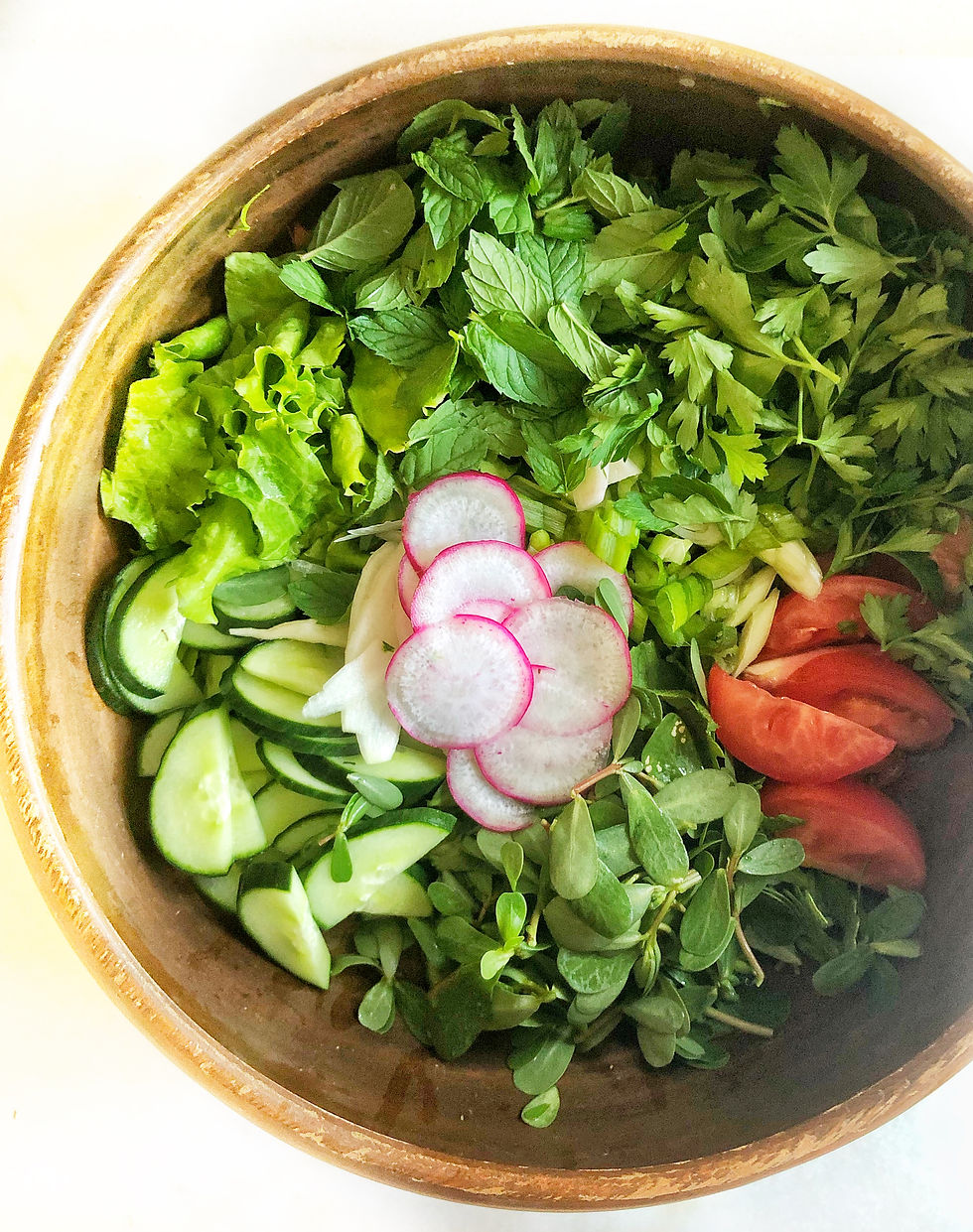
1 head Romain lettuce washed and dried and chopped

3 tomatoes chopped

3 small Persian cucumbers or one large English cucumber diced

1 bell pepper chopped

Radishes shaved about 4-5 radishes

3 green onions chopped

1 Cup or a small bunch fresh Italian parsley chopped

1/2 cup fresh mint chopped

1 cup purslane or a small bunch leaves picked

2 pita breads about 7 inch cut into bite size pieces

Dressing:

Juice of 2 lemons

1/3 cup extra virgin olive oil

1 tbsp sumac

Salt to taste

1 garlic clove minced

1 tsp dried mint leaves

To make the dressing:

Add all the Ingredients to a mason jar

Shake well to combine

Directions:

Preheat the oven to 425F (8-10 min)

Place bread in a baking sheet and toast in the oven until completely dried out and toasted ( we are looking for crispy bread but not burnt) set aside to cool.

Assemble the salad:

Combine lettuce, tomatoes, cucumbers, radishes, scallions, radishes, bell pepper, purslane, mint and chopped parsley.

Toss the vegetables to combine. Add the dressing when ready to serve.

Top the lettuce with the crispy pita right before serving to avoid getting the bread soggy.


  • Pinterest Social Icon
  • Facebook Basic Square
  • Twitter Basic Square

© 2018 by Almond & FIG

bottom of page